1. The Four Keys to Identification
The Cornell Lab of Ornithology popularized the “Four Keys” method, which helps narrow down a bird’s identity systematically.
Size and Shape
Before looking at color, observe the silhouette. Is the bird chunky like a starling or sleek like a swallow? Compare it to birds you already know:
-
Is it smaller than a sparrow?
-
Between a robin and a crow?
-
Larger than a goose?
Pay attention to the bill shape (hooked for raptors, thin for insect-eaters, or conical for seed-crackers) and tail shape (notched, square, or rounded).
Color Pattern
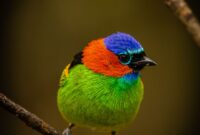
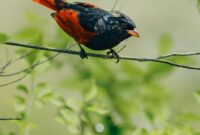
Look for “field marks”—distinctive stripes, spots, or patches of color. Don’t just look at the overall color; look for:
-
Eyelines or eye rings: Stripes through or circles around the eye.
-
Wing bars: Thin lines of color on the wings.
-
Rump patches: A different color on the lower back, visible during flight.
Behavior
How a bird moves can be a dead giveaway.
-
Foraging: Does it creep up tree trunks (like a nuthatch) or hop on the ground (like a sparrow)?
-
Flight style: Does it fly in a straight line, or does it undulate (up and down) like a woodpecker?
-
Posture: Does it sit upright like a hawk or horizontal like a crow?
Habitat
Birds are highly specialized. You are unlikely to see a duck in a desert or a cactus wren in a swamp. Note the environment: is it a dense forest, an open field, a suburban backyard, or a shoreline?
2. Understanding Bird Anatomy (Field Marks)
To describe what you see, you need to know the basic “topography” of a bird.
-
Crown: The top of the head.
-
Nape: The back of the neck.
-
Mantle: The upper back.
-
Primary Feathers: The long feathers at the wingtips, essential for flight identification.
3. The Power of “Gizz”
Experienced birders often use a term called GISS (General Impression of Size and Shape), often pronounced as “Gizz.” It is the “vibe” a bird gives off—the combination of its silhouette, movement, and energy. Over time, you will recognize a Blue Jay or a Robin by its Gizz before you even see its colors.
4. Essential Tools for Success
To identify birds with confidence, you need the right gear:
-
Binoculars: An 8×42 magnification is the standard recommendation for all-purpose birding. It provides a wide field of view and enough magnification to see details.
-
Field Guides: Physical books (like Sibley’s or Peterson’s) are great for study, while apps like Merlin Bird ID (which uses AI to identify photos and sounds) or Audubon Bird Guide are excellent for real-time help.
-
A Journal: Writing down what you see helps cement the details in your memory.
5. Learning Bird Calls (Ear Birding)
Sometimes you hear a bird long before you see it. Every species has a unique “song” (usually for mating or territory) and “calls” (shorter sounds for alarms or flight coordination).
-
Mnemonics: Use phrases to remember songs. For example, the Barred Owl sounds like “Who cooks for you? Who cooks for you all?” and the American Robin sounds like a cheery “Cheerily, cheer-up, cheerily.”
6. Common Identification Pitfalls
-
Juveniles vs. Adults: Young birds often look completely different (usually duller or spottier) than their parents.
-
Seasonal Molt: Many birds, like the American Goldfinch, change from bright yellow in the summer to a dull olive-brown in the winter.
-
Sexual Dimorphism: In many species, the male is brightly colored to attract mates, while the female is drab to stay camouflaged while nesting.
By combining these observations—shape, color, behavior, and habitat—you will find that bird identification becomes less about guessing and more about logical deduction.